
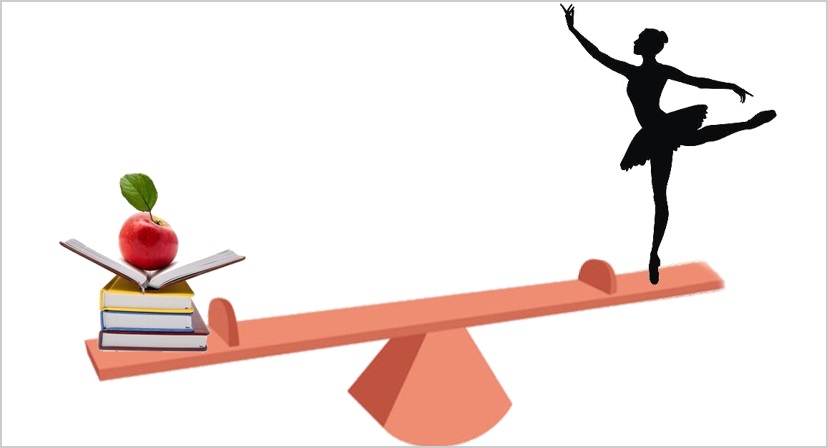
When students enter full-time ballet training, the notion of “regular” school goes out the window. Often, ballet classes start as early as 8 a.m. and run through most of the day, making it impossible for students to attend what most of us consider normal middle school or high school.
Because most serious ballet students move to full-time training by grade 10 or 11, some sort of non-traditional form of academics will need to replace the brick and mortar schools most students attended.
As you and your student are considering a move to full-time training, it’s important to learn about the different types of secondary education available at the various schools. This post will focus largely on North American schools. While we would love to offer more information for schools outside of North America, it falls outside our expertise. As an aside, we would love to hear from any of you who have dancers in non-North American programs so we can become better versed in how academics works there.
Things To Consider
The decision to head off to full-time ballet training is a big one and academics are often the biggest sticking point. Ask yourself if your dancer is ready to leave brick-and-mortar high school and if they can handle a less traditional academic program. The most important factor to consider is how much academic supervision your dancer needs and how self-directed they are. You’ll want to find the best academic match between your student’s learning style and what a particular program offers in terms of support.
Also, a dancer’s academic program should reflect their future plans. Does your dancer have aspirations to go to college after finishing a residential ballet program or do they want to forgo college and start a professional career? There are definitely some schools where graduating students go on to elite colleges and universities and they are supported and even celebrated for those accomplishments.
In other ballet schools, they really don’t want you, if attending college is your dancer’s goal. We’ve even heard of specific teachers asking students what their plans are after high school and the student replied that they thought they wanted to go to college. The teacher replied by asking, “Then why are you here?” Ouch. Obviously, kids change their mind about college vs. pursuing a career out of high school. But, it’s good to know what your dancer plans to do upon finishing at a residential program so that you can match the more appropriate academic program to your dancer’s future plans.
As an example, my son has no interest in attending college in the traditional sense. Although he plans to start taking classes through a local university in the future, he is 100% focused on a professional ballet career right now. In grade 10 he started an online program that was fairly rigorous that offered both honors level and AP classes. During that time, he was registered for both advanced level math classes as well as a few AP classes. It buried him. He is a bright kid, but the time simply wasn’t there for him to do both high level ballet training as well as a rigorous academic program. It also didn’t help that he had little interest in school at the time.
So, we switched him to a less rigorous program from which he graduated last month.
Types Of Non-Traditional Academics
There are four primary categories of non-traditional academics: parent-supervised “home school,” ballet schools with integrated academics, ballet schools that have partnerships with local public and private high schools and finally, online schools/independent study.
Parent Supervised Homeschool
There are a number of ballet students who have been homeschooled prior to starting serious ballet training. Often, these programs are administered by a dancer’s parent. For these students, not much changes when they begin a full-time ballet training program, except that the student may be away from home and academics are administered long distance. One note: we are not aware of many students who, once they started full-time training, went from brick and mortar school to a home school program administered by parents.
Ballet Schools With Integrated Academics
There are a number of schools that purport to have “integrated” academics. One example of this is the Harid Conservatory. However, in this case, integrated academics really means that students do online school with the supervision of proctors and tutors. Pay special attention to what integrated academics really means at a school. Do students attend classes on-site? Or do teachers come to the ballet school? Or, is it really an online program where students are supervised while they do an online academic program?
A few residential ballet programs do offer real integrated academics. Two in particular are Canada’s National Ballet School (commonly referred to as NBS) and University of North Carolina School of the Arts (UNCSA). NBS brings teachers on-site and the school follows the standards of the Ontario Ministry of Education curriculum and students graduate with an Ontario Secondary School Diploma. UNCSA allows high-school students to attend ballet classes in the morning and high-school classes (on-site) in a traditional high-school setting. For families looking for a more integrated situation, these schools might be worth a look.
Schools With Partnerships With Local Schools
Few U.S. residential ballet programs offer partnerships with local schools. The primary one is the School of American Ballet (SAB). SAB has partnerships with both the Professional Children’s School (PCS) as well as the Professional Performing Arts School (PPAS). PCS is private and PPAS is public. Both offer flexible schedules for students where they can attend at least part of the day at the brick and mortar school. In addition, teachers from these schools sometimes come to work with students on site at SAB. And, there are also hybrid programs offered where students can attend classes at these schools online.
Online School
The vast majority of programs available to students are online or independent study programs. In many states, the options are almost endless. There are both private and public options available in most states. The biggest issues to consider with online school are as follows:
Cost
Online private school can be expensive. Money from college savings accounts can be used for online private school, so that may be an option for some families. But, it’s still rather expensive either way. One other issue to consider is that some online private schools will charge a penalty if the student doesn’t complete work by what they deem the end of the marking period. We experienced that with our son when he was doing a private online program.
Full-time ballet programs can take up huge chunks of time during Nutcracker and whatever spring show the school is doing. Unfortunately, that’s also when final exams take place for school. So, if you have concerns about your student’s ability to keep to a schedule, be aware that you may incur charges in certain instances.
If you aren’t interested in paying for private online schools, nearly every state offers free online programs. The main provider of these programs is K-12 (known as a state’s virtual academy e.g. CAVA, California Virtual Academy). This is what some schools that claim to have integrated academics actually use. For example, the Harid Conservatory, which advertises that it offers integrated academics, actually uses K-12 as its main academic provider. Students do their schoolwork in a structured environment, but the delivery of the academic program is still online.
While the supervision is fantastic, make sure you understand what is meant when a school advertises integrated academics and that it offers your student what they need.
Some local school districts may also offer some form of independent study that is administered by a particular high school. Often, that school is the “continuation” high school in the district. Some can be quite rigorous. Others, not so much. More on that in a bit.
Class And Teacher Meeting Times
Meeting times are also important. Does the online school have certain “class times?” Or is it completely asynchronous where students can watch pre-recorded lectures at their convenience or read written materials when they can squeeze it in?
Be aware that if your dancer is considering a program with set class meeting times, it may be a difficult balance with ballet. This is especially true around performance times, given the nature of always changing rehearsal schedules. In addition, think about how it will affect your student’s sleep schedule. We are aware of a ballet student, in the school our kids attended, who was taking an extremely rigorous course load that required she attend set class times. She was swimming in work. And, she was getting up at 6 a.m. to attend a class prior to heading to ballet. This kid was losing sleep and struggling to manage everything at once.
Most online and independent study programs include regular meetings with teachers. As you’re looking into the various programs, try to understand how teacher meetings work and when they take place. These meetings usually happen online but some local programs can include in-person meetings. The most important factor to consider is whether or not the meeting schedule lines up with a ballet schedule.
In addition, find out how flexible and responsive teachers are. Do student emails get a response the same day or does it take three days for a teacher to reply?
Rigor
Managing a full-time ballet schedule with rigorous academics is not for everyone. While there are certainly students who can manage this, not all can. And, that’s absolutely ok. The main thing is to determine which academic program is a good fit for your dancer. Are they capable of high-level work with little to no supervision? Or, do they require some more support?
As far as the online schools go, some are extremely challenging e.g. Stanford Online High School. And, some are less so. The same goes for the public programs.
If you’re considering going the independent study route, it’s important to really understand what the independent study program has to offer. Some can be full of busy work because there is a need to justify that the program is just as “rigorous” as brick and mortar school.
Other independent study programs can be pretty reasonable. When my son switched from an online private school to the independent study program in his school district, it was a welcome reprieve. He completed all of the classes required for graduation. However, no one would accuse him of being ready to go directly into an elite college or university. But, he knowingly chose this route.
You just need to have a good sense of the direction your dancer wants to take.
How To Track Progress
We’ve all seen Canvas, SchoolLoop and the other systems that allow students (and parents) to monitor student progress. As much as some of us pooh-poohed those systems when our kids lived with us, they can be really helpful when your student is far away. When our son was enrolled in a private online high school, the monitoring tools were quite good. Although we never liked what we saw, because he was perpetually behind, we could never claim we didn’t know what was going on!
When he switched to his local school district’s independent study program, the tool for measuring progress was less complete. We could see grades at the end of a marking period, but that was about it. Fortunately, his teacher created a spreadsheet that showed us which assignments had been turned in and what his progress was toward completing a unit or even a full marking period.
As you’re thinking about online programs, remember that your student is farther away and you can’t just yell upstairs and ask them to give you an update on how school is going.
Tips For Managing The Transition
When a dancer switches to full-time training it can be exciting, yet quite stressful. To ease the transition from a more traditional type of academic program to one that is less so, here are some tips to make the transition easier.
Consider starting an online school as a hybrid program with your student’s “regular” school. It may not alway be possible, but it’s worth discussing it with your local school. We had this conversation with my son’s middle school and it resulted in his being able to take two online classes and have an abbreviated school day starting in grade 7. When he finally made the switch to all online school in grade 10, the transition was a bit smoother.
One other thing that really caught us off guard was lab science. Most of the online programs we evaluated either offered lab science classes that did not meet the state’s accreditation requirements or they required that the classes be completed at a local community college.
The other alternative for many programs is that the school mails you a set of equipment and experiments must be conducted in one’s kitchen. If a student is living in a dorm, it’s tough to get access to places where experiments can be conducted. Good luck finding a bunsen burner in most ballet school dorms! To deal with this (my husband had actually looked into the lab science issue when we were evaluating programs), we had our son double up on lab sciences in grade 9. At his brick and mortar school, he took both of the required lab sciences for our state before he started with full online school in grade 10. The non-lab related science classes are no problem, but those that typically require labs can be complicated to do remotely.
As your student switches to online school, time management becomes ever more important. As part of your research into the various residential ballet schools, look into how much academic supervision is provided. Some schools have required study hall attendance and grades must be submitted on a regular basis. In other ballet schools, the student is really on their own for academics. As much as the quality of the ballet training will factor into the choices your dancer makes, academic support should be a large consideration as well, especially if your student struggles with independent study or has any sort of learning challenges.
Another way to prepare for the transition is to have your student try to work ahead at their brick and mortar school. Some teachers, in special circumstances, will allow students to work ahead. By allowing your student to do this, it lets them set their academic pace rather than the pace being set by the teacher. This will give your student a good sense of how quickly they may be able to complete assignments when they are operating more on their own.
Just as your student has blocks of time after brick and mortar school to do homework, students should schedule time to “do school” during the ballet day. Sometimes it helps to team up with other ballet students who may be doing similar academic programs. That way, your student doesn’t feel like they’re the only one studying while everyone else is out doing things that may be more fun!
As with everything in ballet, it’s not easy! But, with some up-front research and planning, you can help smooth the way just a little bit!
One response to “Moving From Traditional School To Non-Traditional Academic Programs”
[…] school. There are four models of non-traditional high school and we cover these in more detail in a post dedicated to non-traditional […]